
This is ED’s third EP. Before we talk about it, let’s recap: what was ED’s original concept? Why was the band formed, and what message does it convey?
Exaltatio Diaboli was formed in London in 2013 out of the need and urgency to play orthodox, uncompromising black metal, while remaining open to stylistic and aesthetic influences. The idea was to take what we were already doing with our two respective bands to the extreme, both lyrically and sonically. I clearly remember that the spark was the release of A Monumental Black Statue’s EP “Alcoholic Tyrants,” and it was precisely from there that “The Adversarial Ascending Force” (TAAF) was born—a more caustic, more militant, and more extreme version of “Alcoholic Tyrants”; in fact, I even used the same guitar sound and the same feral approach to vocals. The lunar message of the lyrics intertwined with a drifting lifestyle, teetering on the edge of poverty, set against an urban, toxic backdrop devoid of any sense of dignity… Inhuman.
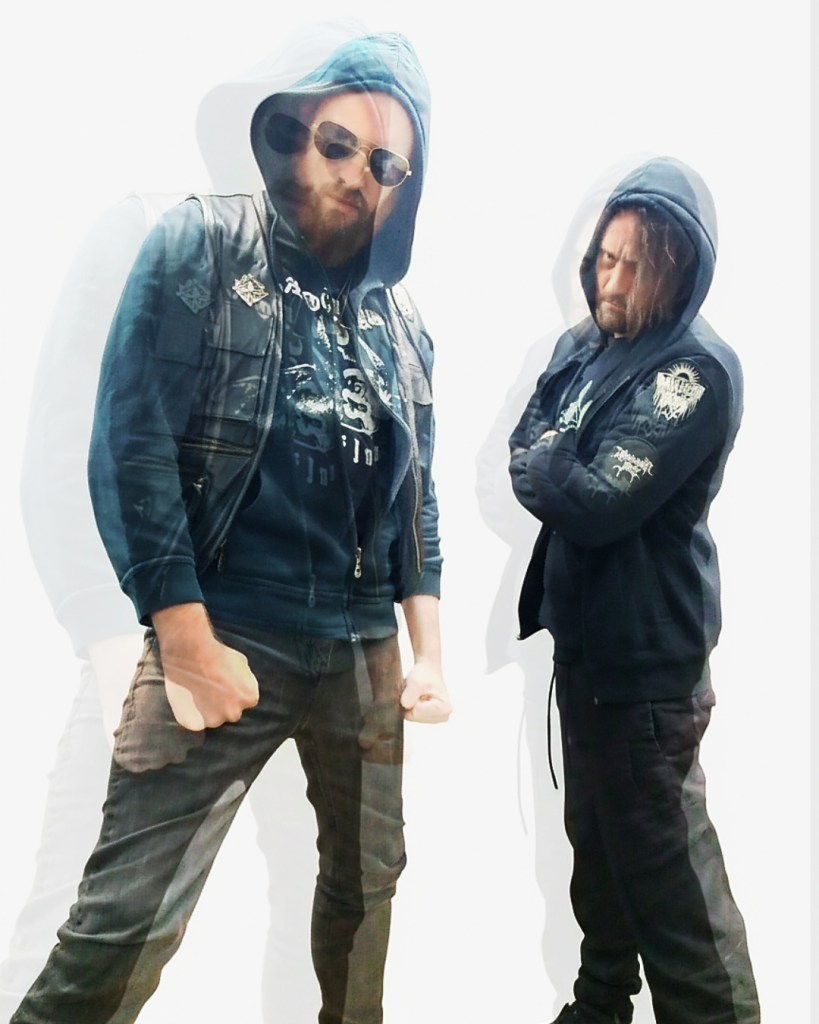
How has your musical style evolved? Are there any bands that have inspired you? Has it changed along the way?
When I look back, I see works with distinct production styles, but in reality I realize that we’ve never really changed; to put it simply, I think we’re still here playing “TAAF” and trying to best reinterpret its many facets and ideas. What’s more, our influences are still the same: the orthodox/religious scene of the early 2000s, the classical music of Béla Bartók, Ligeti, and Stockhausen; the dissonances of Dillinger Escape Plan; the rarefied atmospheres of Reverorum ib Malacht and Abruptum; the despair of Joy Division; the rock hits of Ghost; the epic riffs of Maiden; the religious depth of Hildegard of Bingen… During the years of “Alcoholic Tyrants” and “TAAF,” we also listened to a lot of rap, drill, and trip-hop—sounds that fit perfectly with the decadent atmosphere of London’s East End—as well as Massive Attack, Nine Inch Nails, Marilyn Manson, Richard Moult, and what I consider my greatest influence: the soundtracks of John Williams. All of this, in one way or another, flows into the cacophony and silences of Exaltatio Diaboli.
How and under what conditions do you record? Have these conditions changed over time? How?
This is a tediously complex topic that stems primarily from practical factors. It’s a variable process that can change from album to album and even depending on who happens to be involved in the recordings. The constant for us has almost always been the compositional approach to the songs, but almost never the recording process itself.
Do your album covers always feature different styles? Where does this choice come from? Is there a specific artistic reason behind it?
This is because each work represents a different facet of this entity’s “character.” We like the idea of not letting the listener get used to a single, unchanging stream of emotions; we embrace and encourage change in all its abrupt manifestations. It wouldn’t make sense for us to stick to the same aesthetic; we always prefer trauma to nostalgia, transformation to the security of stagnation.
What is the message of The Ultimate End? What does it convey?
I have a somber visual interpretation of this mournful EP that I associate with leaden colors; I perceive it as a figurative tribute to the metamorphosis that the wizard completes, lifeless, as he passes through the sphere of Venus. But The Ultimate End is also an offering to the most important transition in life: “Death”—and today it is of the dead that we speak, sepulchral spectres already evoked in the late Gibur’s previous EP, *Monasticism*, which, unfortunately, was never released due to an unfortunate ban by Bandcamp.
“Who can wage war against the manifestation of the Numen as time and Death?”
What has changed stylistically from Indomitus to The Ultimate End?
They differ because *Indomitus* is linear, classic, acoustic, raw, melodic, and rustic. *The Ultimate End* was originally conceived as the fourth EP of my now-defunct project Gibur; *TUE* therefore sounds cold, industrial, martial, and dissonant. Right up until the very end, I was unsure whether to release it as a Gibur EP; only at the end did I convince myself that it could very well be part of our discography and that, in some ways, it continues a narrative that began with the album “Fluxion”—an experimental opus that combined the sounds of “Enantiodromia” with those of “Credo.”
This thread connecting Credo (2016), Enantiodromia, Fluxion, and finally The Ultimate End spans a full 10 years. Would you like to tell us about it?
Although they all stem from the same source, these works reflect the historical context in which they were created: they are the products of the visions and feelings experienced at that exact moment. Today I realize that with “Credo” we laid the strongest foundations for Exaltatio Diaboli, truly showcasing our stylistic intentions, and from there on, in each of the titles you mentioned, we developed those concepts further.
“Credo” contains many elements of “Enantiodromia,” and it’s clear that “Fluxion” is its sequel, while “The Ultimate End” differs quite a bit from the others but directly continues the narrative of “Fluxion.”

Looking back, is there anything you would do differently?
I tend to be quite critical of my contributions to our music; there are so many things I would change in our past works if I could, from the production to certain arrangements. At the same time, I think every artistic work is a product of its time. I think it would be easier to list what I wouldn’t do differently; so I’ll tell you that I wouldn’t change a thing about “Enantiodromia,” which I still consider our most successful work and certainly our most extreme… I still listen to it regularly to this day.
Are there any other projects you’re involved in?
Yes, we both have another side project. Nocturnal Fog plays in his band Mourning Soul, which is currently finishing up a full-length album that’s destined to become a true classic in my future playlist; I had the honor of being present during the drum sessions and had the chance to listen to the entire pre-production—what a treat!
As for me, I’m the guitarist in the aforementioned A Monumental Black Statue, a malevolent infernal banner of Etruria, with whom we completed the recordings a few months ago for a project conceived in late 2024 titled “Aukêlos,” derived from the Etruscan “Aurora,” and which will be our seventh (counting “The Dreadful Ones”) full-length album in 20 years of activity and extreme devotion.
Vexator & Rasna Henthu Macstrevc collective.
Ordo quattuor flammarum, pro te pugnamus!
Agios o Lucifer!